OpenAI is paying for Google Search ads on Christmas gift searches, so that people start their gift shopping in ChatGPT instead of on Google. In the UK, people typing "christmas gifts for dads" into Google have been shown a sponsored result headlined "Gift Search with ChatGPT | Gifts for Mom, Dad, and More". Its links offer to sort gifts by budget, find deals and compare products. OpenAI pays Google for every click, and every click takes a shopper out of Google.
Michael Scott, head of organic search at the UK agency Clicky, shared a screenshot of the ad on LinkedIn this week, and Shopifreaks reported it on 9 October. A few people in the comments thought the screenshot was fake. Others said a few hundred searches in October wouldn't make any difference. I wanted to know which of them was right, so I checked the claim against Semrush's paid search data and against Google's own Ads Transparency Center.
The ads are real, and the gift searches turn out to be a small part of a much bigger campaign. I've worked in search since 2003, and for an Australian business owner the question this raises goes well beyond Christmas shopping. Where will your customers be asking their questions next year, and will your business come up when they do?
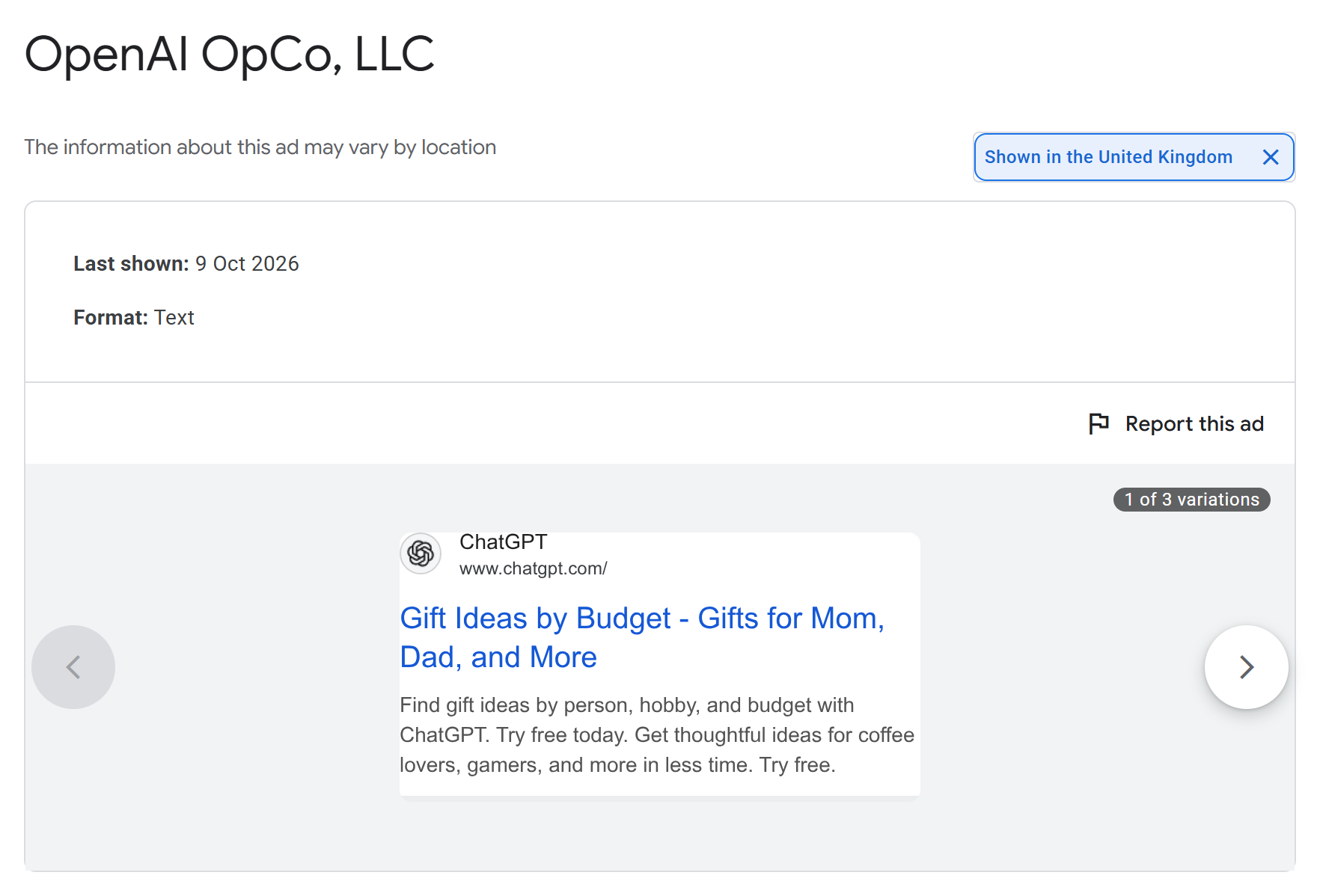
OpenAI's gift ad as Google records it in the Ads Transparency Center: shown in the United Kingdom, last shown on 9 October 2026. Captured 10 October 2026.
What is OpenAI actually buying on Google?
In Semrush's UK data, ChatGPT's ad held first position on 16 gift searches between 19 September and 9 October 2026. They include "gifts to get dads who have everything", "what do i get my boyfriend for christmas", "christmas ideas for your mom", "things to buy your dad for christmas" and "first christmas gift to girlfriend". Most get somewhere between about 100 and 1,300 searches a month in the UK. They're long, rambling, slightly desperate searches, which is pretty much how people talk to a chatbot.
The ad copy tells you what OpenAI is going after:
- "Explore gifts for parents, partners, and friends without endless tabs."
- "Move from vague search to a stronger gift shortlist with ChatGPT."
- "Find gift ideas by person, hobby, and budget with ChatGPT."
- Extensions reading "AI Shopping Assistant" and "Compare Prices".
The ads say "Mom", too, which British readers will have noticed.
Google's Ads Transparency Center confirms who is paying. The account is OpenAI OpCo, LLC, which has verified its identity with Google. Its gift ad, headlined "Gift Ideas by Budget", started running in late August and was still running on 9 October. Google shows it in the UK, Ireland, Spain and Greece. It doesn't appear among the Australian, US or Canadian text ads from the last 30 days, and Semrush's UK history for the past 12 months, which takes in last Christmas, has no ChatGPT ads on gift searches before this September. So this is a new test, running in a handful of European countries for now.
Keyword counts are Semrush estimates for chatgpt.com, which sample search results rather than record every ad. The survey figures come from 500 Australian gift buyers surveyed between 30 July and 3 August 2026.
Six figures on OpenAI's Google advertising and AI gift shopping: ChatGPT's ad held first position on 16 UK gift searches between 19 September and 9 October 2026, Semrush counted 85,637 US keywords triggering ChatGPT ads in June 2026 and 12,077 Australian keywords in July 2026, 33% of Australian Christmas gift shoppers plan to use AI tools this year, 82% of them plan to use ChatGPT, and ChatGPT reaches 1.2 billion people a week.
The gift ads are one small part of a bigger campaign
The gift ad went live in the same late-August week as a set of other shopping ads from the same account. Their headlines include "Search Deals with ChatGPT", "Compare Products Side by Side", "Review Search with ChatGPT", "Best Picks for Your Budget" and "ChatGPT for Dupe Searches". Some of OpenAI's other ads now carry sitelinks labelled "Your shopping guide by AI" and "Shop smarter with ChatGPT".
When OpenAI launched shopping research in ChatGPT in November 2025, it listed the things the feature was built for: finding lookalikes, comparing items side by side, choosing gifts and finding deals. Put that list next to the ad headlines and they line up one for one. Each of those use cases now has its own ad on Google.
The shopping ads are themselves a slice of a much wider spend. In Semrush's US data, ChatGPT ads appear on searches for "gemini" and "google gemini", which is Google's own AI assistant. In the UK they show up on "traductor google", which is Spanish for Google Translate, and on the Chinese equivalent, with an ad for ChatGPT Translate. They also appear on everyday task searches like "spell check", "how to remove background from image", "best transcription software" and "best way to create an org chart". Google's trademark policy allows any advertiser to use someone else's trademark as a keyword, which is how OpenAI can buy the word "gemini" from Google.
The scale has moved a lot in a year. Semrush counted 4,856 Google keywords triggering chatgpt.com ads in its US data in October 2025. By June 2026 the count was 85,637. In Australia it went from 1,309 to 12,077 by July. Both counts then fell sharply in August and September, to 7,922 in the US and 1,838 here. Semrush samples results pages and doesn't see every ad, so treat those figures as estimates. To me they look like OpenAI bought very widely for a few months, then cut back to the searches that paid off. The gift and shopping ads arrived during that cutback.
Google's Transparency Center lists about 2,000 OpenAI ads that have been shown in Australia, and some ads still running this month were first shown in February 2025. OpenAI has advertised on Google for some time, mostly for ChatGPT itself and the tasks it helps with. The shopping ads that started in late August put it up against retailers, on searches they have always paid for.
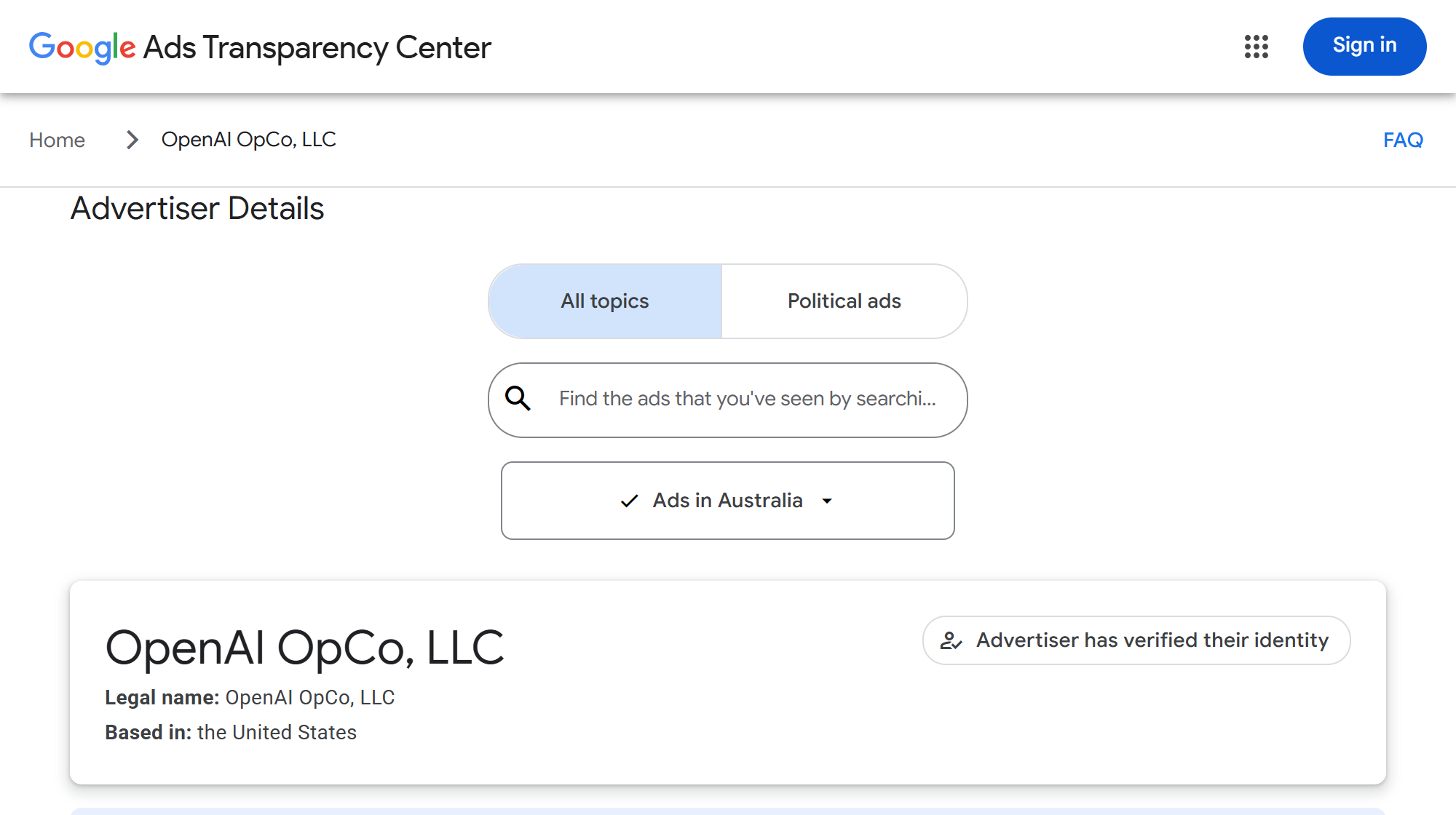
OpenAI's verified advertiser account in Google's Ads Transparency Center, filtered to ads shown in Australia. Captured 10 October 2026.
Why would OpenAI pay Google for this?
The short answer is that Google is still where people ask, and they'll keep asking there unless something breaks the habit.
ChatGPT already has the audience. OpenAI said this month that it reaches 1.2 billion people each week. Most of those people still use Google as well. Similarweb found that 95% of ChatGPT users also used Google in September 2025, and the figure was still 95% in May 2026. SparkToro and Datos looked at desktop searches across 41 major US websites in the last quarter of 2025. Google handled 73.7% of them, and AI tools 3.2%.
So OpenAI has the users, but a lot of their buying questions still start on Google. Buying an ad at the exact moment someone asks one of those questions is the most direct way to change that. If ChatGPT gives someone a better shortlist for their dad's present than ten blue links did, there's a fair chance they open ChatGPT first next time, whether they're after a birthday gift, a new fridge or a plumber.
There's a straightforward commercial reason as well. OpenAI announced ads inside ChatGPT on 16 January 2026, started testing them in the US in February, and brought them to Australia on 17 April, according to AdNews. On 31 August it said ChatGPT ads had reached US$1 billion in annualised revenue in less than 200 days. Every shopping conversation that starts in ChatGPT is now a place OpenAI can sell ads. Paying Google for a click that starts one of those conversations can easily pay for itself.
Other search companies have tried this. In 2024 Microsoft was buying Google ads that sent people to Bing's results, and Barry Schwartz noted at the time that Ask.com did the same over a decade earlier. Neither of them had a product that hundreds of millions of people already used every day for other things, which is the advantage ChatGPT brings to the same tactic.
Why start with Christmas gifts?
Gift searches are the vaguest searches people make. Someone typing "gifts to get dads who have everything" doesn't know what they want, and that's why they're searching. A page of links and a row of product ads doesn't help much with that. A conversation that asks about budget, hobbies and what he already owns helps a lot more, and OpenAI's ad copy says exactly that.
Christmas is also when shopping habits shift. Adobe found generative AI traffic to US retail sites rose 1,300% in the 2024 holiday season and 693.4% in 2025, and it forecasts another 130% rise this year. In the 2025 season, visitors who reached US retail sites from AI tools converted 31% more often than other traffic. Those are US numbers, but Australians are moving the same way. In a survey of 500 Australian gift buyers by Retail Safari and Swinburne University's CXI Research Group, 33% plan to use AI tools for their Christmas shopping this year, up from 16% last year. Of those, 82% plan to use ChatGPT. Visa found last December that 47% of Australians were using AI for gift ideas, research or planning.
Based on the ad copy OpenAI is running on UK gift searches, which promises gift ideas "without endless tabs" and "a stronger gift shortlist".
- The shopper types "christmas gifts for dads" into Google
- They open a dozen tabs of gift guides and shop listings
- Retailers compete on Google for the click
- A ChatGPT ad sits on the same Google results page
- ChatGPT asks about budget and hobbies, then returns a shortlist
- The shortlist is built inside ChatGPT, away from your Google ads
Comparison of a Christmas gift search before and after OpenAI's Google ad. Before: the shopper types christmas gifts for dads into Google, opens a dozen tabs of gift guides and shop listings, and retailers compete on Google for the click. After: a ChatGPT ad sits on the same results page, ChatGPT asks about budget and hobbies and returns a shortlist, and the shortlist is built inside ChatGPT, away from retailers' Google ads.
Do a few hundred searches in October really matter?
The sceptic in Michael Scott's comments has a point about the numbers. Most of the UK searches OpenAI is buying are small, and October is early. Gift search volume builds through November and peaks in December. In Australia, "christmas gift ideas" averages around 6,600 Google searches a month and "secret santa gift ideas" around 2,900 in Semrush's data, and most of that comes in the last few weeks before Christmas.
I'd still take it seriously, for three reasons. First, this is a test running in four countries, at the cheap end of the season, on long phrases where clicks cost very little. That's a sensible way to find out whether a Google click on a gift search turns into a regular ChatGPT user. Second, the long, chatty searches already read like ChatGPT prompts, so they're the obvious place to start. Third, OpenAI has shown it can scale fast. It went from under 5,000 keywords to over 85,000 in the US in eight months, so if the numbers work, it can buy far more than a few hundred searches.
The test itself is the important part. OpenAI is finding out whether paying Google can move the start of a shopping decision into ChatGPT, and anyone who relies on being found in search should watch how that turns out.
What does Google get out of it?
In the short term Google gets paid for every click, and it's hard to argue Google is struggling. Alphabet's Search and other revenue was US$63.3 billion in the June 2026 quarter, up 17% on a year earlier, and Sundar Pichai told investors that AI features were driving growth in searches.
Google is also building its own version of the same thing. Last November it added agentic checkout and a feature that rings local stores for you to AI Mode in the US. In January it launched the Universal Commerce Protocol with Shopify, Etsy, Wayfair, Target and Walmart. In May it said checkout built on that protocol would come to Australia "in the coming months".
So two AI shopping assistants are now competing for the same question, and both want to answer it inside their own product. Whichever one wins, the shortlist for a lot of purchases will be put together inside an AI answer, before anyone gets to a list of websites.
What does this mean for Australian businesses?
OpenAI's gift ads aren't running in Australia yet, but Australians are already doing what the ads are pushing. A third of Australian gift buyers plan to use AI this Christmas, and most of them mean ChatGPT. The money involved is large. The Australian Retailers Association and Roy Morgan forecast A$12 billion in Christmas gift spending last year, an average of A$757 for each person buying gifts, and the ARA says many discretionary retailers make up to two-thirds of their annual profit in this season. Australia Post puts total online shopping at a record A$82.6 billion in 2025.
There are two ways to show up in ChatGPT, and they're easy to mix up.
You can pay. ChatGPT ads have been live in Australia since April, and Australian businesses can buy them themselves through OpenAI's Ads Manager. OpenAI says the ads are labelled and kept separate from ChatGPT's answers, and that advertising doesn't influence those answers.
Or you can be the business ChatGPT recommends in its answer. For retailers, OpenAI's product feed programme is the formal way in, but OpenAI's merchant page says shopping is only live for US users for now. Until it opens here, ChatGPT answers Australian gift questions from what it can read on the web. That means your own pages, along with the gift guides, reviews, comparison articles and forum threads that mention you.
This isn't only a retail issue. Look at the other searches OpenAI is buying: spell check, transcription software, how to remove a background from a photo. People have taken everyday questions like these to Google for twenty years, and the shopping ads extend the same push to buying decisions. Once people are used to asking ChatGPT "what should I buy my dad", it won't take much for them to ask it "who's a good electrician in Parramatta" as well. I wrote about how little of this shows up in your analytics in One in Eight Australians Now Asks AI First, and Cameron Winslow covered what AI answers are doing to Google's top results in You're Still Number One on Google. So Where Did the Enquiries Go?
What to do before December
You don't need to rebuild anything before Christmas. Most of this is checking and filling gaps.
- Ask ChatGPT the gift question your customer would ask, with a budget and a city in it, something like "Christmas present for a dad who loves cooking, under $100, delivered in Brisbane". Run it three times, because the answers change, and write down which businesses and pages it names.
- Check your robots.txt file allows OAI-SearchBot, the crawler OpenAI uses for ChatGPT search. OpenAI says sites that block it won't be shown in ChatGPT's search answers.
- Put the details a gift buyer needs in plain text on your product and category pages: who it suits, the price in Australian dollars, Christmas delivery cut-off dates and your returns policy. AI tools quote what they can read easily.
- Get mentioned in the places ChatGPT reads, which means Australian gift guides, review sites, comparison articles and local press. Ranking on Google won't get you there on its own. In our own monitoring, ChatGPT and Google's AI Overviews had only 8% of their sources in common on the same question (the data is here).
- Keep your Google Merchant Center feed accurate and current. Google's AI shopping features read it, and it's the same kind of product data OpenAI asks merchants for, so a clean feed puts you in a good position if OpenAI's programme opens here.
- Add "ChatGPT or another AI assistant" to the how-did-you-hear-about-us question on your forms and at checkout. Most of this influence won't appear in your analytics, but customers will usually tell you if you ask them.
- Keep your Google spend for now. Nearly everyone who uses ChatGPT still uses Google, and Google is still where most searches happen. What's changing is how many purchases are already shortlisted before the shopper reaches Google.
Most of this can be done with ChatGPT itself, your website and your existing product feed.
Seven step checklist for Australian businesses before Christmas: ask ChatGPT your customer's gift question three times and record who is named, allow OAI-SearchBot in robots.txt, put prices in Australian dollars, delivery cut-offs and returns in plain text, get into Australian gift guides and reviews, keep the Google Merchant Center feed accurate, ask customers whether an AI assistant sent them, and keep Google spend while this shifts.
OpenAI paying Google to send gift shoppers to ChatGPT is a small campaign so far, but it tells you plainly where OpenAI expects shopping decisions to be made. Your business needs to come up there when a customer asks, whether it's a gift question or a question about what you do.
Our free audit shows which businesses AI tools name when your customers ask. See who's taking your enquiries. It takes about a minute.
Sources
- Shopifreaks, OpenAI appears to be buying Google search ads on Christmas gift keywords to steer holiday shoppers from Google to ChatGPT, Paul Drecksler, 9 October 2026. Based on Michael Scott's LinkedIn post and screenshot.
- Google Ads Transparency Center, OpenAI OpCo, LLC advertiser page, checked 10 October 2026.
- Semrush paid search data for chatgpt.com (UK, US and Australian databases), checked 10 October 2026. Semrush samples search results pages, so keyword counts are estimates.
- OpenAI, Introducing shopping research in ChatGPT, 24 November 2025.
- OpenAI, Our approach to advertising and expanding access, 16 January 2026.
- AdNews, ChatGPT ads start in Australia today, 17 April 2026.
- OpenAI, A milestone in expanding access to AI, 31 August 2026.
- OpenAI, Building advertising for the way people use AI, 5 October 2026.
- OpenAI Help Center, Ads Manager availability.
- OpenAI, Power product discovery in ChatGPT, merchant page, read 10 October 2026.
- OpenAI, Overview of OpenAI crawlers.
- Google, Trademarks policy, Advertising Policies Help.
- Similarweb, Is AI replacing search? What the 2026 numbers reveal, Maayan Zohar Basteker, 4 August 2026.
- SparkToro, Search happens everywhere: an analysis of 41 websites with significant search activity, Rand Fishkin, 2026. Datos desktop panel, US, Q4 2025.
- Search Engine Roundtable, Microsoft buying ads on Google Search to drive more searches on Bing, Barry Schwartz, 22 March 2024.
- Adobe, US holiday shopping season to hit record, 28 September 2026. The 2024 figure is from Adobe's March 2025 report and the 2025 result from Adobe's January 2026 release.
- Adobe, AI traffic surges across industries, retail sees biggest gains, Vivek Pandya, January 2026.
- Retail Safari and Swinburne University CXI Research Group, AI Christmas gift shopping research, Australia 2026, 23 September 2026. 500 Australians aged 18 and over who planned to buy gifts, surveyed online 30 July to 3 August 2026.
- Visa, Global inspiration, local confidence: the new habits shaping Australia's holiday shoppers, 23 December 2025.
- Australian Retailers Association and Roy Morgan, Early Christmas shoppers lift retailers' hopes for a solid finish to 2025, 3 December 2025.
- Australia Post, 7 eCommerce trends from the Australia Post eCommerce Report 2026, 19 March 2026.
- Alphabet, Q2 2026 earnings release, 22 July 2026, and Sundar Pichai's remarks.
- Google, Agentic checkout and holiday AI shopping, 13 November 2025; Universal Commerce Protocol, 11 January 2026; Google shopping cart and checkout, 19 May 2026.
- Brain Buddy AI, Five AI Engines, 20,378 Probes: Who Do They Cite?, 28 September 2026.